
“If there are no bacteria, what is in there at all?” Many people react like this when they see information on a package that there are no live bacterial cultures. This reaction is understandable. For decades, communication about microbiological products focused on the number of live cells. The answer is simpler than it seems. Such a preparation contains material from a bacterial culture that can no longer multiply.
Where the idea that only live bacteria count comes from
The definition of a probiotic in the ISAPP consensus from 2014 talks about live microorganisms given in adequate amounts. ISAPP is an international scientific association that publishes statements that put these terms in order. In this definition, being alive is a required condition, not an extra feature.
The market followed the definition. Packages stated the number of live cells in CFU (colony-forming units). This number became the main way to compare products, and often the only one.
So people started to link the two ideas: a microbiological product is a product with live bacteria. The category of inanimate preparations only got an agreed definition in 2021, in another ISAPP statement.
Read more: Postbiotics – what they are and how they differ from probiotics and prebiotics
What is left when the bacteria are gone
A bacterial culture is not only cells. It is also everything the cells produced while they grew and released into their environment. These compounds are called metabolites. Metabolites are the products of chemical changes in the cell.
The liquid after fermentation contains, for example, organic acids, peptides (short chains of amino acids) and exopolysaccharides (complex sugars that the cell releases outside). What this mixture contains depends on the strain and on the growing conditions.
Read more: What bacterial metabolites are and where they come from in fermentation
Apart from metabolites, there is also cell material: inactivated cells and their parts. According to the ISAPP definition, an inanimate preparation should contain cells or their components. Metabolites can be present, but they do not have to be.
So a preparation without live bacterial cultures contains biological material from the culture. What it does not have is cells that can continue to multiply.
How a preparation without live cultures is made
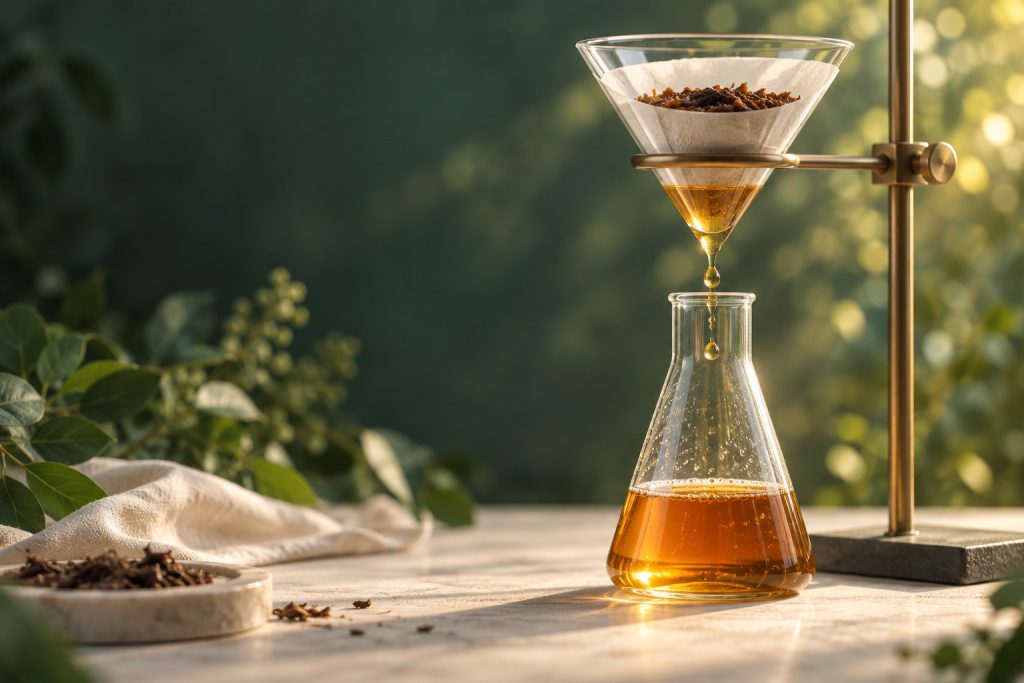
The process starts in the same way as the production of a probiotic. An identified strain is grown in controlled conditions, on a defined growth medium, at a set temperature, pH and process time. These conditions decide what the resulting material contains.
The next step is inactivation. This means the cells lose the ability to multiply. Producers use heat treatment, high pressure, ultrasound, UV radiation or freeze-drying (lyophilisation). The choice of method matters. Different techniques damage the structure of the cell and its compounds to different degrees.
At the end, the preparation is usually concentrated and standardised. This means that each batch gets a similar content. The content is given in units of mass, for example milligrams per portion. A declaration in CFU would not fit here, because CFU only refers to live cells.
One example of a preparation without live bacteria is THESYBIN food supplement. It contains OLINATI.MED® — a fermented strain of Limosilactobacillus reuteri DSM 15693, with added zinc and vitamin B5. After opening, keep in the fridge and use within 30 days.
The challenge for probiotics: survival
The journey through the digestive system
A probiotic product must reach the gut with its cells still alive. On the way, it meets the acidic environment of the stomach, and then bile salts and digestive enzymes. In these conditions, some cells lose the ability to multiply.
Manufacturers deal with this by using coatings that open in the gut, by microencapsulation and by choosing strains that are more resistant to low pH. How well these solutions work depends on the form of the product.
Read more: Liquid supplement, capsule or powder – how the forms differ
In an inanimate preparation, survival is not a problem, because there are no live cells to keep alive. This does not mean that the material passes through the digestive tract unchanged. Acid and enzymes also act on organic compounds.
Storage and transport conditions
The number of live cells falls over time. How fast it falls depends on temperature, humidity and the make-up of the product. The manufacturer states a CFU number that must be valid until the end of the shelf life. This usually means adding extra cells at the start of production.
That is why packages give requirements such as: keep in the fridge, protect from moisture, use soon after opening. The whole supply chain, from the warehouse to the kitchen cupboard, affects how many live cells are left.
Read more: Storing supplements – temperature, light, moisture and the fridge after opening
An inanimate preparation does not have this limit. However, it still needs protection from things that can change what it contains, such as high temperature, light or moisture. The exact advice depends on the form of the product.
Practical differences in everyday use
| Criterion | Preparation with live cultures | Preparation without live cultures |
|---|---|---|
| Stability over time | The number of live cells falls from the moment of production, and the declared number must be valid until the end of the shelf life | There are no live cells to keep alive; stability is about the chemical make-up |
| Storage requirements | Some products need cold storage and protection from moisture | Usually room temperature; details depend on the form of the product |
| Effect of temperature | Higher temperature makes the number of live cells fall faster | No effect on live cells, but high temperature can affect the compounds in the product |
| How predictable the content is | It depends on how fast the cells die in the given conditions | Standardised to the declared content, if the process is repeatable |
| Unit of the declared amount | CFU (colony-forming units) | Units of mass, for example milligrams per portion |
All these differences are technical. They are about how the preparation behaves in the package and what it needs from the supply chain. They are not about what happens after you consume it.
What this difference does not mean
This is the most important part of this text, so please do not skip it. Being less sensitive to storage conditions is not the same as working better. These are two separate questions. The first is about technology and logistics. The second would need data from studies with people, separately for each preparation.
Some things need to be said clearly:
- Having no live bacteria is not a health advantage over probiotics. It is part of the definition of a different category of preparations.
- Research on inanimate preparations is newer and there is less of it than research on probiotics. An agreed definition of this category only appeared in 2021.
- A large part of the available data comes from in vitro studies, which means studies on cell cultures outside the body, and from animal models. The results of such studies are preliminary (Salminen et al., 2021).
- There are few direct comparisons in the literature between live and inanimate preparations from the same source, and their results are not always consistent (Salminen et al., 2021).
- There is no widely accepted unit of measurement that works like CFU. This makes it hard to compare inanimate preparations with each other.
So the honest conclusion is this: an inanimate preparation is easier to standardise and needs less careful storage. However, the question of what effects it has is still open. Only data for a specific preparation can answer it, not the category that the preparation belongs to.
Summary
A supplement without live bacterial cultures contains material from a culture: inactivated cells, their parts and the metabolites that come with them. It is made by the same fermentation process as probiotic products, with an extra inactivation step.
The results are mainly technical. There are no live cells to keep alive until the end of the shelf life. The content is declared in units of mass. The storage requirements are usually less strict.
However, these are not arguments that one category is better than the other. Research on inanimate preparations is at an earlier stage than research on probiotics. So when you judge a product, look at the manufacturer’s data and the information on the label.
FAQ
Is a supplement without live bacteria really not just a spoiled probiotic?
No, these are two different situations. An inanimate preparation is inactivated on purpose during production, and its content is declared in units of mass. A probiotic whose cells died during storage, on the other hand, does not meet its CFU declaration.
Do you need to keep such a preparation in the fridge?
Usually not, because there are no live cells to keep alive. However, the requirements depend on the form of the product and what it contains. Always follow the manufacturer’s information on the package.
Does having no live bacteria mean that a preparation works better?
No, there is no basis for this conclusion. The differences we can be sure about are stability, how the product is standardised and the storage requirements, not the effects of use. There are few direct comparisons of the two categories in the literature.
How can you tell from the label that a preparation has no live cultures?
Look for terms such as “inanimate”, “inactivated”, “no live bacterial cultures”, “lysate” or “ferment”. Another sign is the unit of the declared amount: milligrams per portion instead of CFU. A reliable description also gives the full strain designation with a collection number, for example with the prefix DSM.
Sources
- Salminen S., Collado M.C., Endo A. et al., The International Scientific Association of Probiotics and Prebiotics (ISAPP) consensus statement on the definition and scope of postbiotics, Nature Reviews Gastroenterology & Hepatology, 2021, vol. 18, no. 9, pp. 649-667.
- Hill C., Guarner F., Reid G. et al., Expert consensus document. The International Scientific Association for Probiotics and Prebiotics consensus statement on the scope and appropriate use of the term probiotic, Nature Reviews Gastroenterology & Hepatology, 2014, vol. 11, no. 8, pp. 506-514.
- Marco M.L., Sanders M.E., Gänzle M. et al., The International Scientific Association for Probiotics and Prebiotics (ISAPP) consensus statement on fermented foods, Nature Reviews Gastroenterology & Hepatology, 2021, vol. 18, no. 3, pp. 196-208.
- Commission Regulation (EU) No 432/2012 of 16 May 2012 establishing a list of permitted health claims made on foods, other than those referring to the reduction of disease risk and to children’s development and health.
- Aguilar-Toalá J.E., Garcia-Varela R., Garcia H.S. et al., Postbiotics: an evolving term within the functional foods field, Trends in Food Science & Technology, 2018, vol. 75, pp. 105-114.