
The smell of sauerkraut, the sour taste of yoghurt, the typical note of sourdough starter for bread. None of these features comes from the raw material. Fresh cabbage does not smell like sauerkraut, and milk is not sour. What we smell and taste is the result of the work of bacteria. More exactly, it comes from compounds that these bacteria produced. We call them metabolites.
Metabolite – a definition without jargon
A metabolite is any chemical compound that forms in a cell as a result of metabolism, which means the chemical changes in the cell. The cell takes nutrients from its environment and processes them. Then it releases the products outside or stores them inside.
This is true for every organism, including humans. For example, lactic acid that forms in muscles during exercise is a metabolite. So is urea, which the kidneys remove from the body. In bacteria, the process is the same. Only the products are different.
So the term “bacterial metabolites” means compounds that bacteria produce while they live and divide. It is not one substance or a fixed mixture. It is a whole group of compounds with different structures and properties.
Primary and secondary metabolites
Biochemistry divides metabolites into two groups. Primary metabolites form in the basic metabolic pathways and are directly linked to the growth and division of the cell. They include organic acids, amino acids, vitamins and basic sugars.
Secondary metabolites are not necessary for growth itself. The cell usually produces them in later stages of growth, as a response to conditions in its environment, for example when food runs out. They include bacteriocins, which are proteins that stop other microorganisms from growing.
This division is useful, but the line between the groups is not sharp. The same compound can have different roles, depending on the species of bacteria and the growing conditions. More important than the classification is this: the make-up of the mixture depends on who produces it and in what conditions.
How bacterial fermentation works
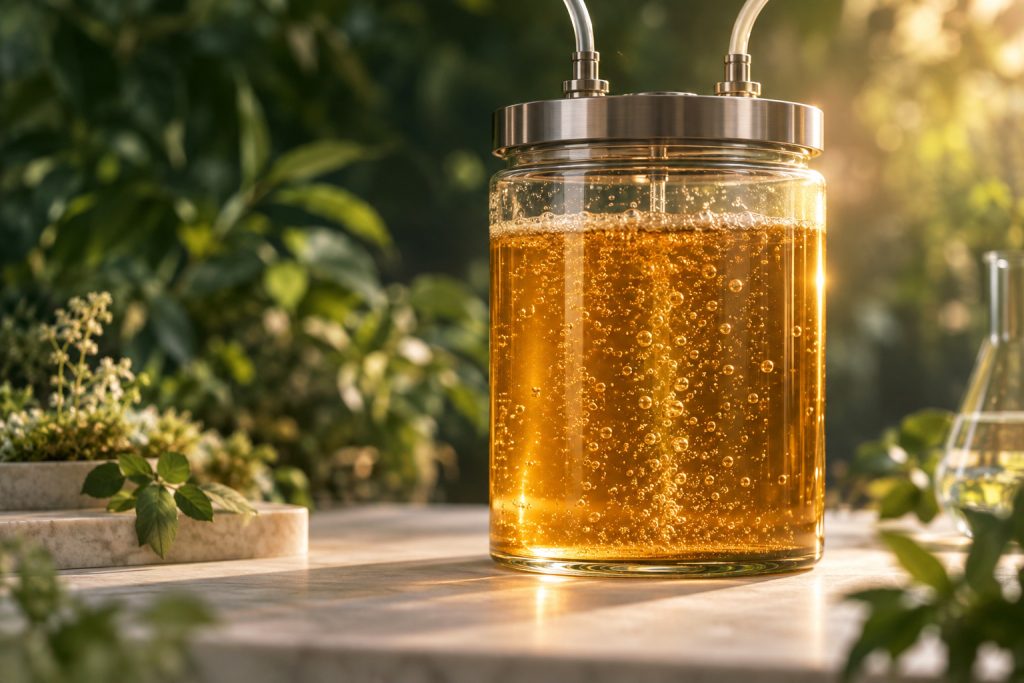
Fermentation is a way to get energy without oxygen. In this process, the cell breaks down organic compounds without using oxygen. Bacteria use this method when there is not enough oxygen, or when a species does not use oxygen at all. The process is the same in a barrel of cabbage and in a controlled bioreactor.
What bacteria eat
The basic fuel is carbohydrates, which means sugars. In cabbage and cucumbers, these are simple sugars from the juice of the vegetables. In milk, it is lactose. In sourdough starter, it is starch and sugars released from flour. This starting material is called the substrate.
Apart from a source of energy, the cell needs nitrogen, most often as amino acids or peptides. It also needs minerals and vitamins. Together, these ingredients are called the growth medium. What the medium contains decides how the whole process goes.
What they leave behind
When bacteria have used the substrate, they release the products of metabolism into their environment. In lactic acid fermentation, the main product is lactic acid. It lowers the pH and preserves the product. Other products are acetic acid, carbon dioxide, ethanol and compounds in very small amounts that give smell and taste.
Bacteria also produce substances that we cannot smell or taste. These include peptides (short chains of amino acids) and exopolysaccharides (complex sugars that the cell releases outside). Some strains also produce B vitamins. Short-chain fatty acids are a separate category. They form mainly in the large intestine when fibre ferments.
Read more: Short-chain fatty acids (SCFA) – what research on the microbiota says about them
Examples of metabolites you know from the kitchen
| Metabolite | Where you find it | How you notice it |
|---|---|---|
| Lactic acid | Sauerkraut, pickled cucumbers, yoghurt, kefir | Sour taste, lower pH of the product |
| Acetic acid | Sourdough starter, vinegar, some pickled vegetables | A sharper smell, like vinegar |
| Carbon dioxide | Sourdough starter, kefir, pickled vegetables in a jar | Gas bubbles, dough that rises |
| Diacetyl | Butter, buttermilk, some cheeses | Buttery smell |
| Exopolysaccharides | Kefir, some yoghurts | Thicker, stringy texture |
All these features have the same source. Bacteria processed the raw material and left behind compounds that were not in the product before. Fermented food is a natural place where bacterial metabolites are found.
Read more: Fermented food in Polish cooking – pickles, sour starters, kefir
Why metabolites can be separated from bacteria
Metabolites that the cell releases are in the culture liquid, not in the bacteria themselves. They can be separated by spinning the liquid in a centrifuge or by filtering it. Bacteria and the compounds they produce are two different things, even though one comes from the other.
In production, the cells are also inactivated. This means they lose the ability to multiply. Producers use heat treatment, high pressure, UV radiation or freeze-drying (lyophilisation) for this. The method matters for the result. Different techniques damage the structure of the cell and its compounds to different degrees.
This is the basis of the postbiotic category. Postbiotics are preparations of inanimate microorganisms or their components, as defined in the ISAPP statement from 2021. Their content is given in units of mass, for example milligrams per portion. It is not given in CFU, because CFU only refers to live cells.
Read more: Postbiotics – what they are and how they differ from probiotics and prebiotics
How science studies metabolites
To describe what a mixture of metabolites contains, scientists mainly use chromatography and mass spectrometry. These methods split a complex sample into single compounds and measure how much of each there is. The field that describes the whole set of metabolites in a sample is called metabolomics.
To study how metabolites interact with the body’s cells, researchers use in vitro models (cell cultures outside the body) and animal models. In these models, scientists watch how cells of the gut lining and the immune system behave. Results from such studies are preliminary. They do not directly apply to the human body (Salminen et al., 2021).
The research material itself is still a problem. The mixture of metabolites changes with the strain, the growth medium, the temperature, the pH and how long the process lasts. Also, there are no standard methods to describe what the mixture contains. This makes it hard to compare results (Salminen et al., 2021).
Summary
Bacterial metabolites are compounds that form as a result of chemical changes in bacterial cells. They are not new. They have been part of cooking for thousands of years and give fermented products their taste, smell and texture.
What they contain depends on the strain and on the fermentation conditions, so it is not fixed. A large part of these compounds leaves the cell, so they can be separated from the bacteria. The technology of inanimate preparations uses this. Knowledge about how single metabolites interact with the human body is still at an early stage.
FAQ
Are bacterial metabolites toxins?
Not in general. A metabolite is any product of a cell’s metabolism. The word “toxin” refers to a small group of compounds that some species of bacteria produce. Lactic acid from sauerkraut and a bacterial toxin are two different things, even though both are metabolites.
Does yoghurt from the fridge contain metabolites?
Yes, this is a natural result of fermentation. The sour taste of yoghurt comes from lactic acid that bacteria produced during the process. The smell comes from compounds in very small amounts.
What is the difference between metabolites and live bacteria in a preparation?
Live bacteria are cells that can multiply. Metabolites are compounds that these cells produced. A preparation can contain one, the other or both, and the label should say this. The unit of the declared amount is also different: CFU for live cells and units of mass for inanimate preparations.
Sources
- Salminen S., Collado M.C., Endo A. et al., The International Scientific Association of Probiotics and Prebiotics (ISAPP) consensus statement on the definition and scope of postbiotics, Nature Reviews Gastroenterology & Hepatology, 2021, vol. 18, no. 9, pp. 649-667.
- Marco M.L., Sanders M.E., Gänzle M. et al., The International Scientific Association for Probiotics and Prebiotics (ISAPP) consensus statement on fermented foods, Nature Reviews Gastroenterology & Hepatology, 2021, vol. 18, no. 3, pp. 196-208.
- Gibson G.R., Hutkins R., Sanders M.E. et al., Expert consensus document: The International Scientific Association for Probiotics and Prebiotics (ISAPP) consensus statement on the definition and scope of prebiotics, Nature Reviews Gastroenterology & Hepatology, 2017, vol. 14, no. 8, pp. 491-502.
- Commission Regulation (EU) No 432/2012 of 16 May 2012 establishing a list of permitted health claims made on foods, other than those referring to the reduction of disease risk and to children’s development and health.
- Koh A., De Vadder F., Kovatcheva-Datchary P., Bäckhed F., From dietary fiber to host physiology: short-chain fatty acids as key bacterial metabolites, Cell, 2016, vol. 165, no. 6, pp. 1332-1345.