
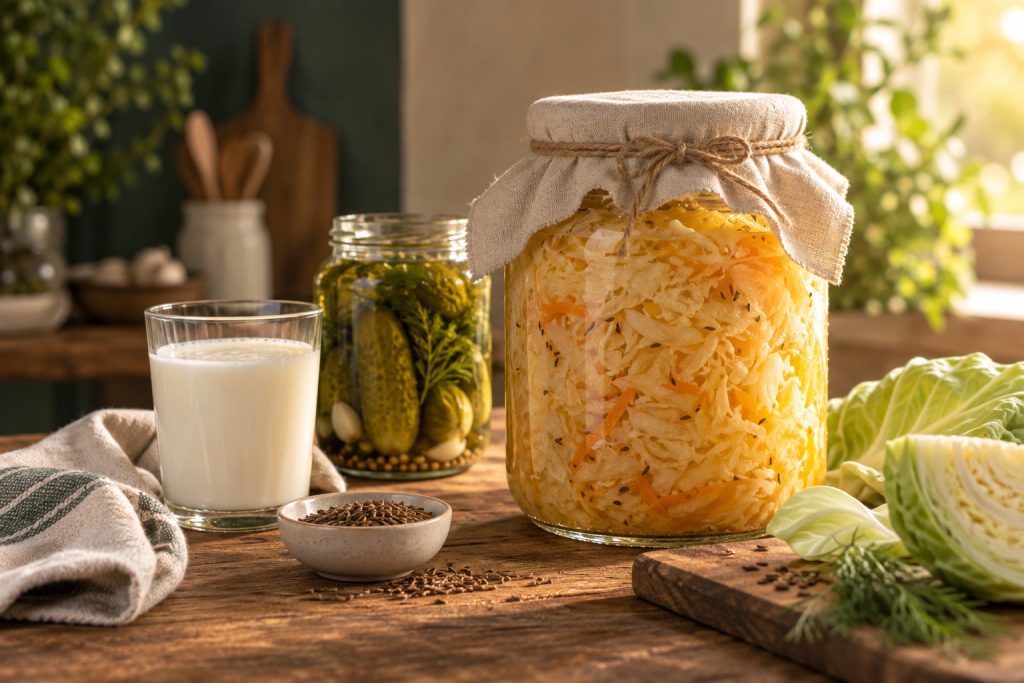
In Poland, people used fermentation to keep food long before it became a subject of scientific research. A barrel of cabbage in the cellar, jars of cucumbers and a sour starter for żurek soup were practical solutions from a time without fridges. Only later did scientists describe what happens in these processes at the level of microorganisms. Below we explain the basics.
How fermentation works
Fermentation is a process without oxygen in which microorganisms change the components of a raw material and get energy from them. In pickled vegetables and dairy products, the main role is played by lactic acid bacteria. They are naturally present on vegetables or are added as starter cultures.
According to the 2021 ISAPP statement, fermented foods are foods made through the controlled growth of microorganisms and the conversion of food components.
What happens to sugars
The starting point is the sugars in the raw material: simple sugars from the cell juice in cabbage and cucumbers, lactose in milk and starch in rye flour.
Bacteria convert them and release lactic acid, and in smaller amounts acetic acid, carbon dioxide and other compounds. These give the sour taste, the smell and the gas bubbles in the jar.
Why the food does not go off
The key factor is a lower pH, which means the environment becomes more acidic. This limits the growth of many microorganisms that make food go off.
The second factor is salt, which has a technical role. It draws water out of plant tissue and forms brine. It also affects which microorganisms grow at the start of the process.
The third factor is no contact with air: vegetables should stay under the brine, because yeasts and moulds grow more easily where the food touches the air.
Pickled or soured – why they are not the same
In Polish, the two words are sometimes used to mean the same thing: in some parts of the country, “soured cabbage” is simply pickled cabbage. In language, this is a matter of local habit.
There is, however, an important difference in how the food is made. A pickled product is made through fermentation by bacteria. A soured product has acid added to it, usually vinegar, without a microbial process.
This matters when you shop: cucumbers in vinegar and pickled cucumbers are two different products, even if they look similar. The ingredients list tells you which one it is.
It is also worth checking whether the product was pasteurised. Heat treatment after fermentation makes the product last longer, but it stops the activity of the microorganisms.
Polish fermentation classics
| Food | Raw materials | Type of process | How to recognise it |
|---|---|---|---|
| Pickled cabbage | White cabbage, salt | Spontaneous fermentation | Sour taste, strong smell |
| Pickled cucumbers | Field cucumbers, salt, spices | Spontaneous fermentation | Cloudy brine, sour taste |
| Beetroot sour starter | Beetroot, water, salt | Spontaneous fermentation | Dark colour, sour taste |
| Rye sour starter for żurek soup | Rye flour, water | Mixed fermentation | Sour aroma |
| Kefir | Milk, kefir grains | Lactic acid and alcohol fermentation | Slightly fizzy, traces of alcohol |
| Buttermilk and soured milk | Milk | Lactic acid fermentation | Thick texture, mild sourness |
Pickled cabbage
Pickled cabbage is made through spontaneous fermentation by microorganisms that are naturally present on the raw material. Typical recipes use an amount of salt close to two per cent of the weight of the cabbage.
The process happens in stages, and the mix of microorganisms changes as the environment becomes more acidic. The result depends on the variety, temperature and time. This is why pickled cabbage from the same recipe can taste different.
Pickled cucumbers
Cucumbers are pickled in brine made of water and salt, with garlic, dill and horseradish. The brine becomes cloudy during the process because microorganisms grow in it.
It is important to keep the cucumbers under the brine for the whole fermentation time. Parts that stick out above the liquid most often change in unwanted ways.
Beetroot sour starter and żurek
Beetroot sour starter is made from beetroot, water and salt, often with garlic and spices. In traditional cooking, it is the base for barszcz (beetroot soup).
Rye sour starter for żurek soup is made from rye flour and water. It is an example of mixed fermentation, in which yeasts take part together with lactic acid bacteria, as in sourdough for bread.
Kefir, buttermilk, soured milk
Kefir is made with kefir grains, which are clusters of bacteria and yeasts. So the fermentation produces both lactic acid and alcohol, and the drink contains small amounts of carbon dioxide and alcohol.
Traditionally, buttermilk is what is left after making butter. Today it is also a fermented drink made with bacterial cultures. In the past, soured milk was made by leaving raw milk to go sour on its own. Shop products are made from heat-treated milk with added cultures.
One difference is worth noting: a fermented food is not the same as a probiotic. A probiotic means live microorganisms given in a suitable amount, with properties described for a specific strain.
More: Probiotic, prebiotic, synbiotic, postbiotic – four terms that people often confuse
What forms during fermentation
During the process, the make-up of the food changes compared with the raw material. Organic acids form, mainly lactic acid, as well as carbon dioxide and compounds in very small amounts that create the smell and taste.
Bacteria also produce peptides, which are short chains of amino acids, and exopolysaccharides, which are complex sugars released outside the cell. Together, these compounds are called metabolites.
More: What bacterial metabolites are and where they come from in fermentation
The make-up of this mixture is not fixed: it depends on the raw material, the microorganisms, the temperature and the time. This is why two batches of the same product can be different.
Fermented food is still part of the diet, not a supplement. Describing its make-up does not mean giving it a health effect. When companies talk about food, they can only use the claims permitted by Regulation (EU) No 432/2012.
More: Gut microbiota – how it develops and what shapes it throughout life
Things to remember
Salt content
Pickled vegetables contain a lot of salt, because salt is a necessary part of how they are made. This applies to both home-made and shop products.
People on a low-sodium diet should count pickles in their daily total. Packaged products show the salt content on the label, as food labelling law requires.
For home-made products, it is harder to estimate, because the amount of salt depends on the recipe. If you have questions about a low-sodium diet, talk to a doctor or dietitian.
Home fermentation and hygiene
Fermenting or preserving food at home in the wrong way can be dangerous. If the environment is not acidic enough and there is little air, unwanted microorganisms can grow, including some that produce toxins.
The basic safety rules are simple:
- Clean containers and tools. Wash jars, stoneware crocks and lids and scald them with boiling water before use.
- Fresh raw materials. Do not pickle vegetables that are damaged, starting to rot or have been stored for a long time.
- The right amount of salt. Using less salt than the recipe says changes how the process goes.
- Keep it under the brine. The raw material should stay under the liquid for the whole fermentation time.
- Controlled temperature. A temperature that is too high speeds up the process and makes unwanted changes more likely.
- Check before eating. An unusual smell, mould, a slimy texture, a lid that bulges or an unusual colour are reasons not to eat the food.
The most important rule: if in doubt, do not taste or eat the food. The State Sanitary Inspection publishes detailed guidance on preparing food at home.
Industrial and home fermentation
Industrial production is based on repeatable results: producers use starter cultures with a known make-up and control the temperature and time. This gives a similar product in each batch.
Home fermentation varies more, because it uses the microorganisms present on the raw material and in the surroundings. This gives a variety of tastes, but the result is harder to predict.
The third difference is how long the product lasts. Some shop products are pasteurised. This makes them last longer, but it stops the activity of the microorganisms.
Summary
Fermentation is a process without oxygen in which microorganisms convert the sugars in a raw material and produce lactic acid and other compounds. Together with salt and little contact with air, the acidity made it possible to keep food long before fridges existed.
Polish classics include pickled cabbage and cucumbers, beetroot and rye sour starters, and fermented milk drinks. A pickled product is not the same as one soured with vinegar.
Remember two things: pickles contain a lot of salt, which matters on a low-sodium diet, and home fermentation needs good hygiene, because it can be dangerous if done in the wrong way.
More: Dietary fibre – how much we really eat and how much institutions recommend
FAQ
Are supermarket pickles the same as home-made ones?
Not always. Some shop products are fermented, some are soured with vinegar, and some are pasteurised after fermentation. The ingredients list tells you which.
Do I need to pour away the pickle juice?
This is a matter of taste, not safety. However, remember that the brine contains salt from the whole process, which matters for people who limit sodium.
Does kefir contain alcohol?
Yes, in trace amounts, because yeasts also take part in kefir fermentation. The amount is small and depends on the fermentation time and conditions.
How can you tell that pickles have gone wrong?
The warning signs are: mould, an unusual or rotten smell, a slimy texture, an unnatural colour and a jar lid that bulges. In this situation, do not taste or eat the food.
Sources
- Marco M.L., Sanders M.E., Gänzle M. et al., The International Scientific Association for Probiotics and Prebiotics (ISAPP) consensus statement on fermented foods, Nature Reviews Gastroenterology & Hepatology, 2021, vol. 18, no. 3, pp. 196-208.
- Hill C., Guarner F., Reid G. et al., Expert consensus document. The International Scientific Association for Probiotics and Prebiotics consensus statement on the scope and appropriate use of the term probiotic, Nature Reviews Gastroenterology & Hepatology, 2014, vol. 11, no. 8, pp. 506-514.
- Regulation (EU) No 1169/2011 of the European Parliament and of the Council of 25 October 2011 on the provision of food information to consumers.
- Commission Regulation (EU) No 432/2012 of 16 May 2012 establishing a list of permitted health claims made on foods, other than those referring to the reduction of disease risk and to children’s development and health.
- Chief Sanitary Inspectorate (Poland), information materials on food safety, https://www.gov.pl/web/gis
- Regulation (EC) No 178/2002 of the European Parliament and of the Council of 28 January 2002 laying down the general principles and requirements of food law.