
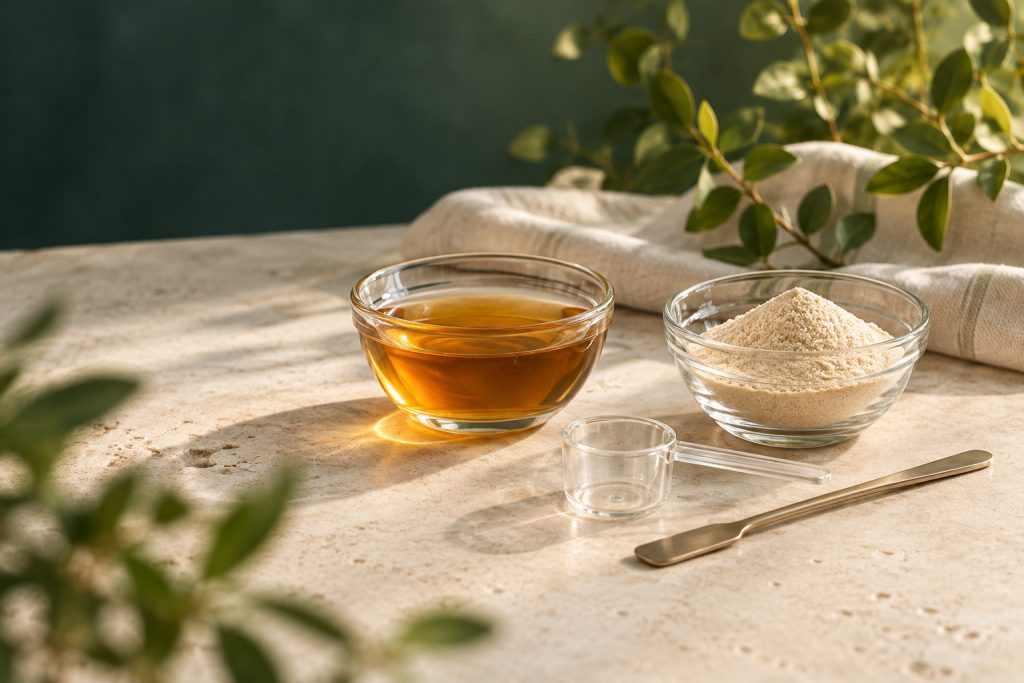
The same substance can go on sale in four different forms: in a bottle with a measuring cup, in a capsule, in a tablet or in a sachet of powder. The differences between them are mainly technical and practical. They are about measuring, storage and daily use. Below, we explain how these forms really differ and what you cannot say about them.
The four main forms of supplements
Liquids
Liquid products are solutions, suspensions or syrups. The ingredient is in a carrier, usually water. You measure the portion with a measuring cup, a spoon or a dropper.
This form lets you change the size of the portion, because you can measure the volume to the nearest millilitre. But it needs a solution for microbiological safety. A product with a lot of water makes it easier for microorganisms to grow, so manufacturers use preservation, lower pH or aseptic filling.
One example of a product in this form is the THESYBIN food supplement in a 195 ml glass bottle, with a daily portion of 6.5 ml measured with a pump.
Read more: A supplement without live bacterial cultures – how it is possible and what it changes
Capsules
A capsule is a shell filled with powder, granules or an oil suspension. It is usually made from gelatine or cellulose derivatives. This matters for people on a plant-based diet.
The practical advantage is a measured portion: one capsule always has the same contents. The shell also hides the taste and smell of the filling.
The limit is size: a capsule holds a set weight of filling, so larger portions are split into several capsules a day.
Tablets
A tablet is made by pressing powder, and this needs excipients: fillers, binders and lubricants. The list of ingredients can be the longest here. This comes from the technology, not from the quality of the product.
Tablets usually stay stable during storage and are cheap to make on a large scale. They can also have a coating that changes where the contents are released, for example an enteric coating.
One disadvantage can be the size when a tablet has a lot of an ingredient. Another is that it is hard to split a portion if the tablet has no break line.
Powders and sachets
Powder is sold in a larger container with a scoop or in sachets with a measured portion. It can give larger amounts of an ingredient than a capsule, without taking several capsules.
Powder from a larger container needs measuring and dissolving, and this means the amount can be less accurate. A sachet removes this problem, but it creates more waste.
Solubility and taste can be a limit: not every raw material dissolves well, and it is harder to hide the taste than in a capsule.
Comparison table
| Form | Accuracy of dosing | Convenience when travelling | Storage needs | Shelf life after opening | Who may find it more convenient |
|---|---|---|---|---|---|
| Liquid | Depends on how accurately you measure | Limited: weight, volume, risk of leaks | Often in a fridge after opening, protected from light | Usually the shortest, the manufacturer gives the time | People who find it hard to swallow tablets |
| Capsule | High, portion measured in the factory | High, small pack, no measuring | Usually room temperature, protected from moisture | Long, until the best before date | People who value speed and no taste |
| Tablet | High, limited splitting of portions | High, usually the smallest pack | Usually room temperature, protected from moisture | Long, until the best before date | People who use a product for a long time |
| Powder | High for sachets, for a larger container it depends on measuring | High for sachets, low for a larger container | Protected from moisture, tightly closed | Depends on how much moisture the raw material absorbs | People who need larger portions |
The table describes typical situations, not a rule without exceptions. The manufacturer gives the detailed requirements on the pack.
Read more: Storing supplements – temperature, light, moisture and the fridge after opening
The myth of better absorption
Marketing materials often say that liquid products are better absorbed because they do not need to dissolve. This is a simplification, and as a general statement it has no basis.
Absorption, described by the term bioavailability, depends on many factors, and the form of the product is only one of them. The most important factors are:
- The type of substance. Water-soluble and fat-soluble compounds behave differently, whatever the form of the product.
- The chemical form. The body can absorb the same element in different compounds to a different degree, both from capsules and from liquids.
- The product matrix. Other substances in the product can make absorption easier or reduce it.
- The conditions of intake. Whether you eat a meal, what the meal contains and the time of day affect how the body absorbs many ingredients.
- Individual factors. Age, the condition of the digestive tract, the medicines you take and the composition of your microbiota.
The form of the product matters when breaking down and dissolving slow the process, for example when a raw material that does not dissolve well is pressed into a tablet. This is a special case for a specific substance and formula. It is not a general rule.
So you cannot say that one form is better absorbed than another without looking at the substance. Comparisons make sense only for a specific ingredient, and they need data for both products.
When the liquid form can be more practical
The first situation is difficulty swallowing. This affects some older people, children and people after procedures on the oesophagus.
The second is the need to change the size of the portion: you can measure any volume, without splitting a tablet or counting capsules.
The third is taking the product with a drink or food: a liquid product is easier to mix with a drink, always as the manufacturer advises.
Read more: How to use liquid supplements without losing their properties
The fourth is raw materials where a capsule could hold too little. A bottle lets you take a larger volume without splitting the portion.
When the liquid form can be less convenient
This section is just as important, and it also applies to products in this category.
Travelling with a bottle is not easy. It takes up space and weighs more than the same product in capsules. It can leak, and on a plane there are limits on liquids in hand luggage.
Measuring means the amount can be wrong. A portion from a measuring cup can be less accurate than a capsule measured in the factory, especially when you are in a hurry.
Storage can be more demanding: after opening, some liquid products need to be kept cold and used within a set time.
There is also the taste and the daily routine. A liquid product has a taste that you cannot fully hide, and a bottle with a measuring cup is less handy than a blister pack.
Read more: How to build a supplement routine and stop forgetting your daily portion
How to choose the right form for you
Base your choice on practical questions, not on statements about absorption.
- Do you find it hard to swallow? If you do, liquids and powders are usually easier to use.
- Where will you take the product? At home, any form works. When you travel or at work, capsules and sachets are easier.
- What does your daily routine look like? A form that you forget to take will not help, whatever it contains.
- What are the storage conditions? Check that you have a place to keep the product as the manufacturer advises.
- Does the capsule shell matter to you? For capsules, this matters for example for people on a plant-based diet.
- How much of the substance is in the daily portion? This question is the same for all forms, and it decides more than the form itself.
Summary
Liquids, capsules, tablets and powders differ in the accuracy of measuring, convenience of use, storage needs and shelf life after opening. These are practical and technical differences.
These differences do not decide absorption. Absorption depends on the substance, its chemical form, the matrix and individual factors. So the statement that any form is better absorbed as a rule has no basis.
Each form has advantages and limits, including the liquid form, which is not easy for travelling and needs more care in storage. The way to choose is still the same: which form you can use regularly, and what the daily portion contains and in what amount.
FAQ
Does a liquid supplement work faster than a capsule?
You cannot say this without looking at the specific substance. How fast the body absorbs it depends on its properties, its chemical form, whether you eat a meal and individual factors.
Is a tablet with a long ingredient list worse?
The length of the list does not make it worse. Excipients are technically necessary when tablets are pressed. What tells you about the product is the amount of the ingredient in the daily portion and how precisely it is described.
Can I dissolve a capsule in water or split a tablet?
Only if the manufacturer allows it. Some forms have coatings or release systems. If you damage them, the product works in a different way. So follow the information on the pack, and if you are not sure, ask a pharmacist.
Which form should I choose for a child or an older person?
The practical measure is how easy it is to take, so liquids and powders can be more convenient for these groups. But the product must be intended for that age group, as the label says. If you are not sure, ask a doctor or pharmacist.
Sources
- Regulation (EU) No 1169/2011 of the European Parliament and of the Council of 25 October 2011 on the provision of food information to consumers.
- Directive 2002/46/EC of the European Parliament and of the Council of 10 June 2002 on the approximation of the laws of the Member States relating to food supplements.
- Commission Regulation (EU) No 432/2012 of 16 May 2012 establishing a list of permitted health claims made on foods, other than those referring to the reduction of disease risk and to children’s development and health.