

Fibre is one of the few parts of the diet that most people know they should eat more of, and still they do not. It rarely causes strong feelings and it does not sell as something new. At the same time, it is one of the best-described parts of the diet. Below we explain what fibre is, how much institutions recommend and why there is a gap between the recommendations and what people really eat.
What dietary fibre is
Dietary fibre is a group name for carbohydrates and related substances that the enzymes of the human digestive tract cannot digest. Unlike starch or simple sugars, they are not broken down in the small intestine. They travel further in a largely unchanged form.
This name covers a group of very different substances: cellulose, hemicelluloses, pectins, beta-glucans, inulin, plant gums and lignin. Formally, lignin is not a carbohydrate. These substances differ in their chemical structure and in how they behave in the digestive tract.
Food labelling law has its own definition of fibre. The terms “source of fibre” or “high fibre” can only be used when a food meets the amount conditions in Regulation (EC) No 1924/2006.
One difference is worth noting: the permitted health claims apply to specific types of fibre and to their conditions of use, not to fibre as a category. The list of these claims is in Regulation (EU) No 432/2012.
Soluble and insoluble fibre
How they differ
The basic division is based on how well fibre dissolves in water. The soluble part forms solutions of different thickness. The insoluble part keeps its structure and increases the volume of the gut contents.
The difference also applies to fermentation. Bacteria in the large intestine usually ferment soluble parts more easily. They ferment insoluble parts less, for example cellulose.
In practice, this division is only a convention: most foods contain both parts in different amounts.
Where to find them
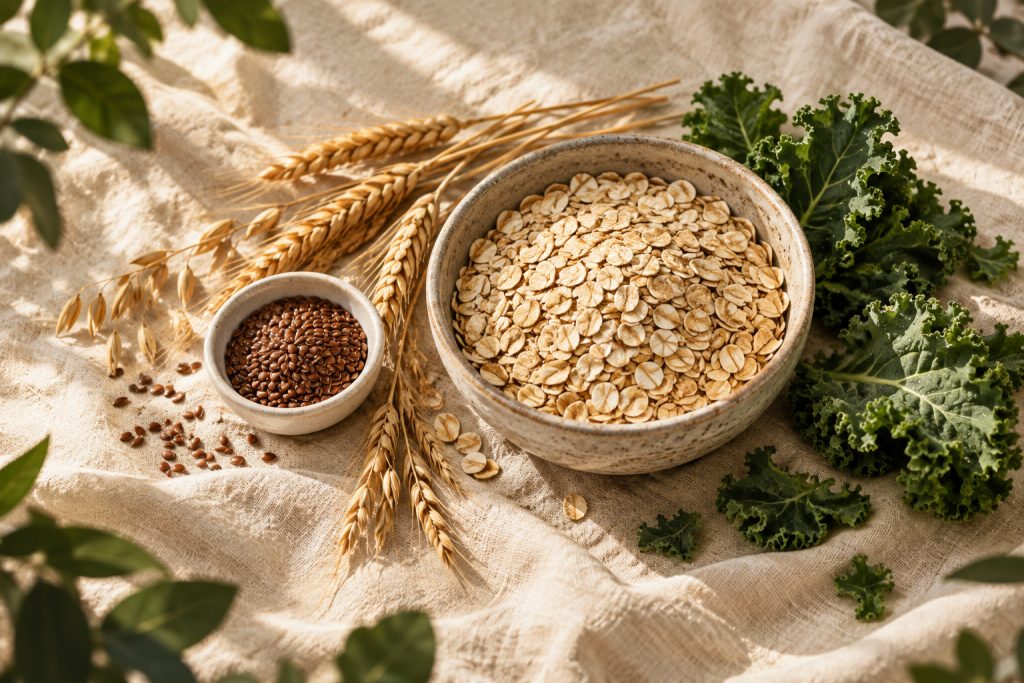
Soluble parts are found, for example, in oats and barley, pulses, berries and linseed. Insoluble parts are most common in wheat bran, wholegrain products, root vegetables and fruit skins.
The practical conclusion: a variety of sources matters more than choosing one food. A diet based on several groups of plant foods gives a wider range of fibre types than a single added product.
What happens to fibre in the large intestine
Fibre and resistant starch reach the large intestine. There they become food for the bacteria that live in it. This is where fermentation happens, which is a process without oxygen that gets energy from these components.
More: Gut microbiota – how it develops and what shapes it throughout life
The products of this process include short-chain fatty acids, known as SCFA, and also gases. These compounds are among the parameters that researchers measure most often in microbiota studies.
More: Short-chain fatty acids (SCFA) – what research on the microbiota says about them
Not every type of fibre ferments to the same degree and at the same speed. This depends on its structure, how finely the food is broken up, the make-up of the microbiota and how long the contents take to pass through the gut.
The insoluble part works mainly in a mechanical way, by increasing the volume of the gut contents. This describes a physical effect. It is not a health claim.
How much fibre institutions recommend
The European Food Safety Authority set an adequate intake of fibre for adults at 25 g a day. This value comes from its 2010 opinion on dietary reference values for carbohydrates and dietary fibre.
In Poland, nutrition standards are prepared by the National Institute of Public Health NIH – National Research Institute. According to the 2024 update of the standards, the value for people aged 19 to 65 is 25 g a day.
In its 2023 guideline on carbohydrate intake, the World Health Organization recommends that adults eat at least 25 g of fibre a day. This fibre should come from foods that naturally contain it, not from supplements.
These are reference values for the population, not individual recommendations. The need for fibre depends on age, sex, energy intake and health.
How much fibre an average diet provides
Diet surveys in European countries, including Poland, show that average fibre intake is below the reference values. The exact numbers differ between studies and age groups. For this reason, it is best to take the exact value from source reports, such as the Polish national WOBASZ II survey or the nutrition standards published by the National Institute of Public Health NIH.
Reports give the same reasons for this gap again and again: people eat more refined grain products than wholegrain ones, they eat few vegetables and pulses, and highly processed foods make up a large part of the diet.
The gap between the recommendation and reality is not caused by a lack of knowledge. Consumer surveys show that people know quite well that fibre is important. The problem lies in everyday choices.
Practical sources of fibre in Polish cooking
The values below are approximate and help you compare the size of the amounts. The fibre content depends on the variety, processing, preparation method and producer. For exact data, check food composition and nutritional value tables or the product label.
| Food | Example portion | Approximate fibre content |
|---|---|---|
| Wheat bran | 2 tablespoons (about 15 g) | a few grams, a very rich source |
| Pulses (cooked) | half a glass (about 90 g) | a few grams |
| Buckwheat or barley groats (cooked) | a portion of about 150 g | a few grams |
| Wholemeal rye bread | 2 slices (about 70 g) | a few grams |
| Oat flakes | 4 tablespoons (about 40 g) | a few grams |
| Root vegetables and cabbage-family vegetables | a portion of about 150 g | up to a few grams |
| Fruit with skin, for example an apple or a pear | 1 medium piece | up to a few grams |
| Nuts and seeds, for example linseed | a handful or a tablespoon | up to a few grams |
The table shows a pattern that is more important than the single numbers: you get your fibre from several portions of different foods during the day, not from one added product. Fermented foods sometimes add to the diet, but they are a source of other components.
More: Fermented food in Polish cooking – pickles, sour starters, kefir
How to increase fibre step by step
A sudden increase in fibre is sometimes not well tolerated. It can cause discomfort such as bloating or a feeling of fullness. For this reason, experts recommend making changes step by step, over several weeks.
In practice, this means changing one part of your diet at a time: replacing white bread with wholegrain bread, adding vegetables to one meal a day or eating pulses once a week.
A variety of sources also matters, not only the amount.
More: What has a negative effect on the gut microbiota – diet, stress, medicines, sleep
The role of drinking enough fluids
When you increase fibre, you should also drink enough fluids. The types of fibre that hold water need it to do their physical job in the digestive tract.
This is a general recommendation that nutrition institutions repeat in their materials. It does not replace individual advice about how much to drink, which depends on your health.
When to be careful
Do not skip this section. People with diseases of the digestive tract should talk to a doctor or dietitian before they change their diet, because general recommendations do not take individual situations into account.
This applies especially in the following situations:
- Diagnosed inflammatory bowel disease or other long-term conditions of the digestive tract.
- Irritable bowel syndrome and other conditions that need special dietary advice.
- The time around surgery, or a recommended diet with reduced fibre.
- Problems with swallowing, narrowing of the digestive tract, repeated bowel blockages.
- Symptoms that do not go away: severe stomach pain, blood in the stool, weight loss without trying, a sudden change in bowel habits.
In these situations, a doctor or dietitian decides how to change the diet. This text is for education and does not replace such advice.
Summary
Dietary fibre is not one component but a group of substances with different structures that behave differently in the digestive tract. By convention, they are divided into soluble and insoluble parts, and most foods contain both.
The European Food Safety Authority gives an adequate intake of 25 g a day for adults. It is worth checking national and international recommendations in current source documents. Diet surveys show that average intake in the population is lower than the reference values.
In practice, you build up fibre in your diet from several portions of different plant foods a day. Increase them step by step and drink enough fluids. People with diseases of the digestive tract should discuss these changes with a doctor or dietitian.
FAQ
Is fibre from vegetables different from fibre from grain products?
The share of the different parts is different. In wholegrain products and bran, the insoluble part is usually larger. In fruit, pulses and oats, the soluble part has a bigger share. This is why a variety of sources in your diet matters.
What does “source of fibre” on the packaging mean?
It is a nutrition claim. A product can only use it if it meets the amount conditions set out in EU law. The same applies to the term “high fibre”, which has a higher threshold. The exact threshold values are in the annex to Regulation (EC) No 1924/2006.
Can you eat too much fibre?
A very fast increase is sometimes not well tolerated and can cause digestive discomfort. For this reason, experts recommend making changes step by step and drinking enough fluids. If you have a disease of the digestive tract, talk to a doctor or dietitian.
Does cooking reduce the fibre content?
Heat treatment changes the structure and volume of a food. Values in tables usually refer to either the raw or the cooked food, and you cannot compare these two values directly. When you compare foods, check which form the number refers to.
Sources
- EFSA Panel on Dietetic Products, Nutrition and Allergies, Scientific Opinion on Dietary Reference Values for carbohydrates and dietary fibre, EFSA Journal, 2010, vol. 8, no. 3, 1462.
- Regulation (EC) No 1924/2006 of the European Parliament and of the Council of 20 December 2006 on nutrition and health claims made on foods, including the annex that sets out the conditions of use for claims about fibre.
- Commission Regulation (EU) No 432/2012 of 16 May 2012 establishing a list of permitted health claims made on foods, other than those referring to the reduction of disease risk and to children’s development and health.
- Gibson G.R., Hutkins R., Sanders M.E. et al., Expert consensus document: The International Scientific Association for Probiotics and Prebiotics (ISAPP) consensus statement on the definition and scope of prebiotics, Nature Reviews Gastroenterology & Hepatology, 2017, vol. 14, no. 8, pp. 491-502.
- Normy żywienia dla populacji Polski [Nutrition standards for the population of Poland], National Institute of Public Health NIH – National Research Institute, 2024 update, https://www.pzh.gov.pl/normy-zywienia-2024/
- World Health Organization, Carbohydrate intake for adults and children: WHO guideline, Geneva 2023.
- Kunachowicz H., Przygoda B., Nadolna I., Iwanow K., Tabele składu i wartości odżywczej żywności [Tables of food composition and nutritional value], 2nd edition, PZWL Medical Publishing, Warsaw 2017.
- Multi-centre National Population Health Examination Survey WOBASZ II (2013-2014), National Institute of Cardiology.