
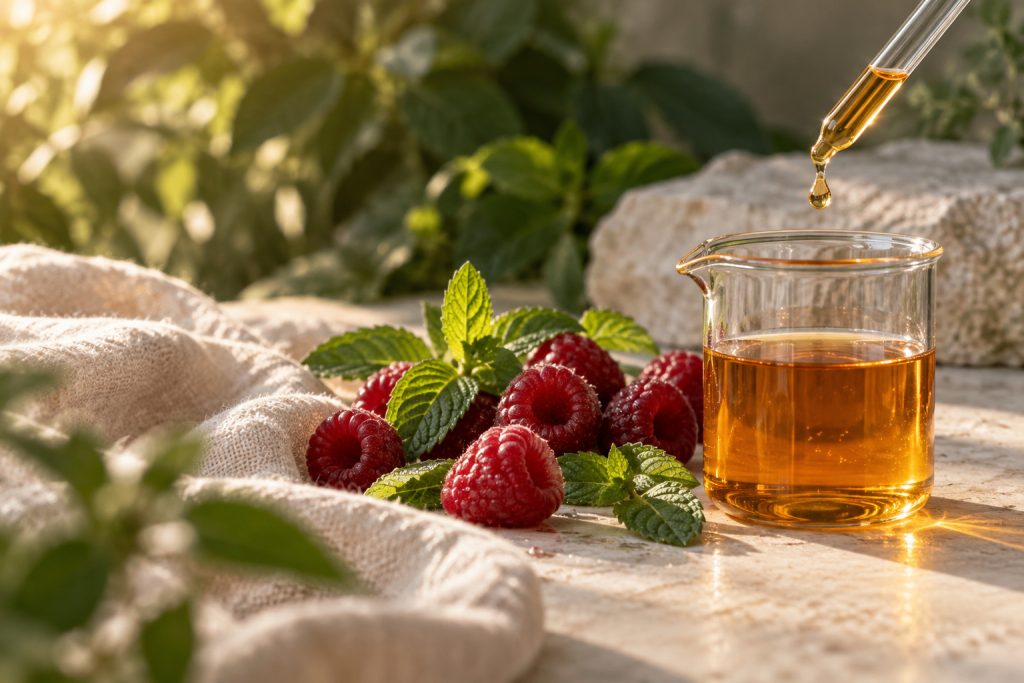
Two products can taste exactly the same and have very different words on their labels. On one you read “natural pineapple flavouring”, on the other simply “flavouring”. The difference is about where the raw material comes from and how it is made, not about taste. It is useful to know what these words mean, because people sometimes read them as information about quality, which they are not.
Why manufacturers add flavourings at all
A flavouring has a technical function: it gives or corrects the taste and smell of a product. This matters in practice in liquid products, because raw materials can be bitter or have a strong smell of their own.
The second reason is consistency. Raw materials differ from batch to batch, and a standardised flavouring gives a similar taste in each new batch.
The third reason is how pleasant the product is to take. A product that you take every day is easier to use when the taste is not a problem. This is an argument about taste and smell, not about health.
What a flavouring is under the rules
The main law in the European Union is Regulation (EC) No 1334/2008 on flavourings. It defines what can be called a flavouring, which categories exist and how to label them.
Among other things, the rules separate flavouring substances (single chemical compounds), flavouring preparations made from source materials, and flavourings that form during heating.
Flavouring substances used in food go through a safety assessment and are on an EU list. Implementing Regulation (EU) No 872/2012 adopted this list and added it to Annex I to Regulation (EC) No 1334/2008. Authorisation means that a substance passed this procedure, whether it comes from a plant material or from synthesis.
Natural flavouring – the legal definition
Where the raw material must come from
A natural flavouring is one whose components come from plant, animal or microbiological materials. The permitted processes are physical, enzymatic and microbiological, including fermentation.
So what matters is the origin of the raw material and how it is processed, not the chemical composition of the final product. The same molecule may or may not count as a natural flavouring, depending on how it was made.
When the name of a fruit can be added
The words “natural flavouring” alone do not tell you where it comes from. But if the label adds the name of the raw material, for example “natural pineapple flavouring”, a specific rule applies.
Under Regulation (EC) No 1334/2008, this wording is allowed when at least 95 per cent of the weight of the flavouring component comes from the named source. The other 5 per cent may only be used for standardisation or to give a stronger note.
If the named raw material makes up less than this, but you can still recognise its taste, the label says something like “natural pineapple flavouring with other natural flavourings”. So a difference in the wording on the label matches a difference in the proportions.
Nature-identical flavouring and synthetic flavouring
The term “nature-identical flavouring” meant a substance made by synthesis, with the same structure as a compound found in nature. This category existed in older rules based on a directive from 1988.
Regulation (EC) No 1334/2008, which has applied since 2011, removed this category. Today the rules allow the words “natural flavouring” or simply “flavouring”.
So today the word “flavouring” without an adjective covers both nature-identical substances and compounds that do not exist in nature. The label does not show which one it is.
This means that the words “nature-identical flavouring” most probably come from older material, not from a current label of a product sold in the EU.
Why “natural” does not mean “better”
Do not skip this section, because people sometimes read the legal difference as a difference in quality. There is no basis for saying that natural flavourings are healthier or safer than synthetic ones.
There are several reasons, and it is worth listing them clearly:
- The same molecule. A compound from a plant material and the same compound made by synthesis have exactly the same chemical structure, so the body cannot tell where it came from.
- The same assessment. Flavouring substances go through a safety assessment, whatever way they are made, and the authorisation covers set conditions of use.
- Natural does not mean harmless. Some compounds found in nature have limits on their use, so origin is not a measure of safety.
- Purity of the raw material. A natural flavouring can be a mix of many compounds, and a synthetic one can be a single, well-described substance. Neither situation is better by definition.
The division into natural flavourings and others is a legal category that describes origin and technology. It is not a quality scale. When you choose a product, the amount of active ingredient in the daily portion and a precise description of the ingredients matter more.
Read more: How to read the ingredients of a food supplement – what to look at beyond the marketing name
How to recognise the type of flavouring on the label
| Wording on the label | What it means |
|---|---|
| Flavouring | A flavouring that does not meet the conditions for the word “natural”. It covers substances that are identical to those found in nature and substances that are not found in nature |
| Natural flavouring | Components made from plant, animal or microbiological materials by permitted processes. The source is not named |
| Natural [name of raw material] flavouring | At least 95 per cent of the weight of the flavouring component comes from the named raw material |
| Natural [name] flavouring with other natural flavourings | You can recognise the named raw material, but it makes up less than 95 per cent |
| Smoke flavouring | A separate category with its own requirements |
But the label does not say which substance was used or in what amount. Flavourings do not need a statement of quantity, so you can only assess them by category.
Summary
The difference between natural flavouring and other flavourings is about the origin of the raw material and how it is made. It is not about the taste or the properties of the product. This is a legal difference, described in Regulation (EC) No 1334/2008.
The category “nature-identical flavouring” no longer exists and should not appear on current labels. Today the allowed wording is “natural flavouring”, sometimes with the name of the raw material, and simply “flavouring”.
None of these words is a measure of quality. Other parts of the label tell you more about the product: the ingredients, the amount of active substance in the daily portion and how precisely the ingredients are described.
FAQ
Does a natural flavouring always come from the fruit in its name?
Only when the label gives the name of the raw material, for example “natural pineapple flavouring”. The words “natural flavouring” alone only mean that the components come from plant, animal or microbiological materials. They do not name the source.
Why does the label not give the name of the specific flavouring substance?
Because the labelling rules say that flavourings are labelled with the name of their category. The manufacturer does not have to list individual substances or their amounts. This makes flavourings different from most ingredients.
Is a product without flavouring better?
The lack of flavouring alone does not make it better. Adding a flavouring is a technical decision that depends on the taste of the raw materials.
Sources
- Regulation (EC) No 1334/2008 of the European Parliament and of the Council of 16 December 2008 on flavourings and certain food ingredients with flavouring properties for use in and on foods.
- Regulation (EU) No 1169/2011 of the European Parliament and of the Council of 25 October 2011 on the provision of food information to consumers.
- Council Directive 88/388/EEC of 1988 on the approximation of the laws of the Member States relating to flavourings for use in foodstuffs (repealed).
- Commission Implementing Regulation (EU) No 872/2012 of 1 October 2012 adopting the list of flavouring substances provided for by Regulation (EC) No 2232/96 and introducing it in Annex I to Regulation (EC) No 1334/2008.